May 232013
 

Building "Future Crew" console #1
Do you enjoy playing Space Team, but find that you want tactile controls? Or like the Artemis Bridge Simulator, but think it is too serious? Do you love pushing buttons, turning knobs and shouting at each other? Then you’ll really have fun playing Future Crew at the NYCR Interactive Party!

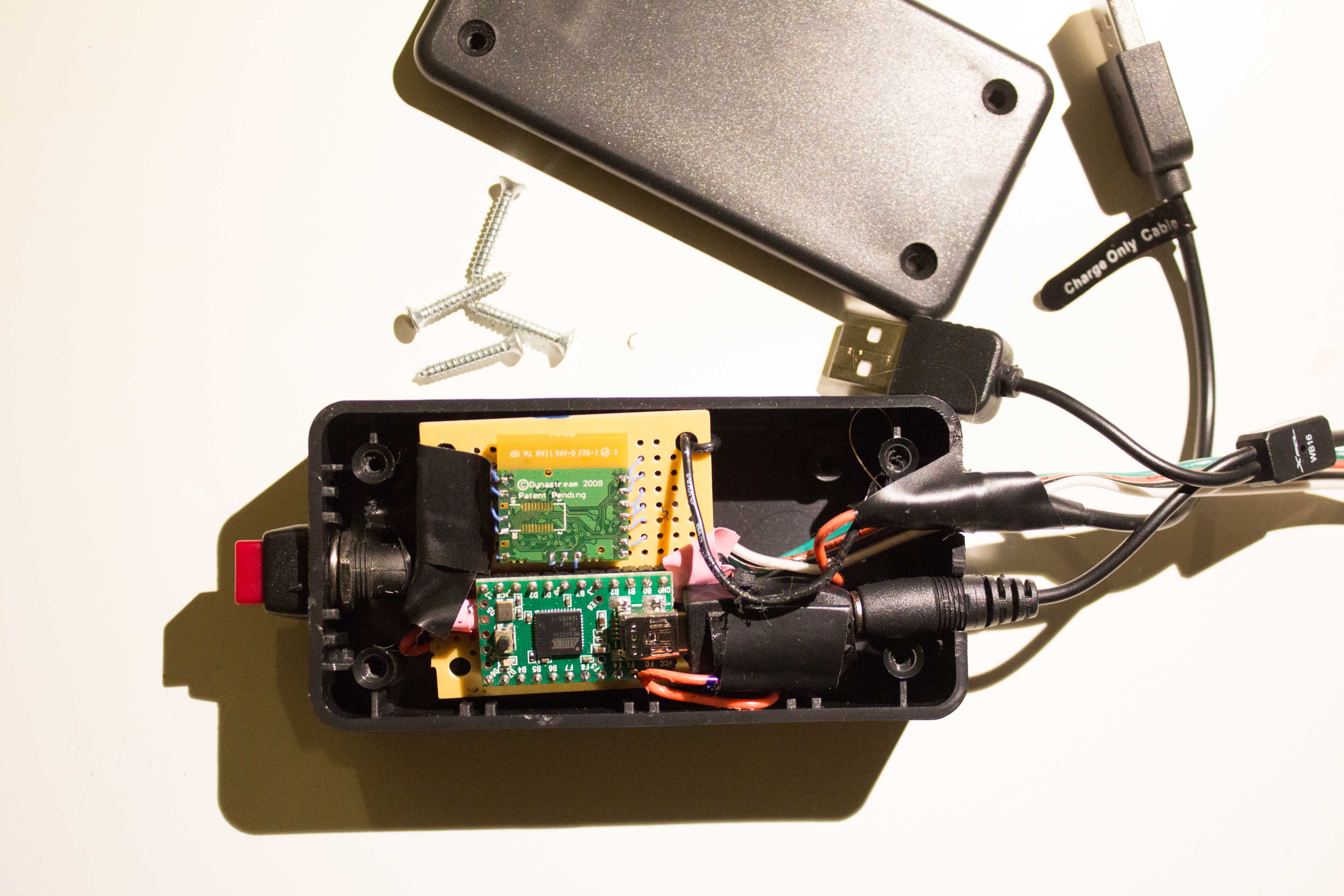
Future Crew push button panel construction
Since the theme of the party is “Digital Archeology”, all of the control stations are being built from repurposed dead hardware. There’s a patch panel, push buttons, strobe lights, more push buttons, quadrature knobs, oscilloscopes, and maybe even a teletype to keep score.

Future Crew display console
Each console will have a Raspberry Pi with Wifi to talk to the other consoles, some number of Teensys to talk to the real world, and some sort of glitchy way to communicate to the operator (like an NTSC TV or a Minitel). If things don’t work right, that’s part of the fun. And, of course the source code will be available for you to build your own Future Crew Consoles.

Tickets for the party are on sale now!

 Posted by at 8:12 pm
Jan 062013
 

TRS80 + Teensy
Thirty years ago in 1983 the first tablet computer was released: the Tandy / RadioShack TRS-80 Model 100. It ran for weeks on four AA batteries and gathered quite a following. Despite the $1099 ($1399 with extra 8-KB of memory) introductory price tag, features like the built in 300 baud modem with acoustic couplers made them very popular with reporters in the field, and the built-in BASIC programming language (written by Bill Gates himself!) made them easy to adapt into various custom applications. Over six million were produced and as a result, inexpensive, used Model 100s are readily available now. Amazingly many of them still work perfectly and there is a somewhat active Club100 fan club.

TRS-80 Model 100 motherboard versus Teensy++ version
I bought one that was non-functional for $20 with the goal of replacing the 80C85 motherboard with a more modern AVR or ARM CPU. While this particular motherboard had failed sometime ago due to bad capacitors, the LCD and keyboard were in perfect working order. Thanks to the combination of the age of the design, the system’s low original clock speed (2.4 MHz) and its 5 V logic make it simple for modern hardware to drive. Moore’s Law also means that the entire motherboard can be shrunk into a PCB with almost zero chips other than the MCU. Read on for what is involved in building a new brain for your Model 100. Continue reading »

 Posted by at 7:44 pm
Dec 272012
 

AVR RFID
I was inspired by Beth’s avrfid.S project to try to build a replacement for the multiple HID Prox cards that I carry for work. Her design is simultaneously a technical tour-de-force and an example of how badly we can abuse the Atmel chips. Here is the entire schematic:

There is no connection to power and ground: the chip is powered through leakage current from the input pins. The AC waveform is fed directly into the pins: the internal protection diodes rectify it. During negative parts of the wave the silicon die’s inherent capacitance maintains state. The CPU clock is driven by the AC as well and depends on the ability of the coil to drive more current than the chip when DDRB is configured to pull the pins to the same potential. It’s truly amazing that this works at all.

AVR RFID waveforms
The firmware she wrote in macro assembler is easy to understand and straightfoward, but filled the entire 8 KB flash on the ATTiny85 when compiled for HID Prox cards. Unlike the CW modulated EM41xx cards that just load the coil for thirty RF cycles to send a baseband one and don’t load the coil to send a baseband zero, the HID cards use Frequency Shift Keying (FSK) modulation. In FSK a baseband zero is sent by cycling the load on the coil for 50 cycles at a frequency of 4 RF cycles, and a baseband one is sent by cycling the load every 5 RF cycles. Beth’s code loads the coil by setting the two bits in DDRB to 1 while holding PORTB at 0, which places a short across the coil by putting both ends at the same potential.

While it turns out that my dream of automatically selecting the right RFID card doesn’t work, read on for details of how to build your own HID compatible RFID devices and some overview of the hand-tuned assembly necessary to fit the RFID timing. Continue reading »

 Posted by at 11:23 pm

AlphaWatch

 Uncategorized  2 Responses »
Nov 182012
 

A quarter past
I found Matt Joyce’s HDSP211x alphanumeric displays in the LED bin at NYCR and loved the StarTAC style. He had previously written about driving them, but using an Arduino and a shift register on a breadboard was a bit large for my goal of making it into a wristwatch.

Teensy backpack for the HDS2111 LED display
I noticed that the PDIP spacing was the same as the Teensy 2.0 and, much like my ROM dumper, hoped that it could fit on the back of the display with almost no additional wires. Read on for the “schematics” and source code details.
Continue reading »

 Posted by at 3:50 pm

Robot Army

 Uncategorized  7 Responses »
Nov 132012
 

Three PUMA arms
A friend recently acquired a set of PUMA 260 / RP Automation robot arms and asked for some assistance in getting them running again.

PUMA wiring harness
Unfortunately they had been removed from their previous occupation with a set of wire-cutters. Some wires were labeled, most were not. But after a few weekends with a multimeter and some oscilloscope work, we have it running again. Read on for how to bring these arms back to life.
Continue reading »

 Posted by at 9:30 pm
Oct 072012
 

USB mill controller and e-stop
Do you want to be able to control software with interesting things?

USB Iambic Morse Keyboard
Do you want to type text in a weird way?

WASD keyboard
Do you often need to type just the W-A-S-D and space keys?

"Hack it"Standing desk with foot pedals
Or do you have have ideas for repurposing devices to connect them to your computer? Then sign up for the USB Human Input Device class at NYC Resistor next weekend, 14 October 2012!

The class covers writing firmware for the AVR to implement various USB HID classes, such as keyboards, mice and joysticks, using both raw USB calls and Arduino libraries. Included in the class is a Teensy 2.0, a breadboard and switches for building a simple human input device that you can take home to prototype your next gadget project. Anything with buttons, pedals, sliders or knobs can be used to make an input device once you know how!

 Posted by at 10:21 am

USB Analog Gauge

 Uncategorized  4 Responses »
Sep 172012
 

Badass gauges
Perhaps at your hackerspace you have a pile of “badass gauges” and want to do something with them. How about a USB interface, a laser cut enclosure and an RGB status indicator LED?

USB Gauge

Read on for the vague construction details and some software to drive random DC current and voltage gauges that you might find.
Continue reading »

 Posted by at 8:59 pm
Jul 292012
 

PROM dumper
So you want to dump a ROM, but don’t have a breadboard? You can use a Teensy, some female-female jumpers and if you have one, a ZIF socket. I cut the power and ground wires and soldered three additional leads to each one to provide hard-wired values for for Vpp and !PGM signals at +5V, and the !CS and !OE signals at ground potential. To make wiring easier, my code in prom.c maps the address lines sequentially down the left side of the Teensy, and the data lines sequentially down the right side. Using every pin on the teensy provides 14 bits of address line and 8 bits of data, allowing up to 16 KB PROMs to be dumped.
Continue reading »

 Posted by at 10:27 pm