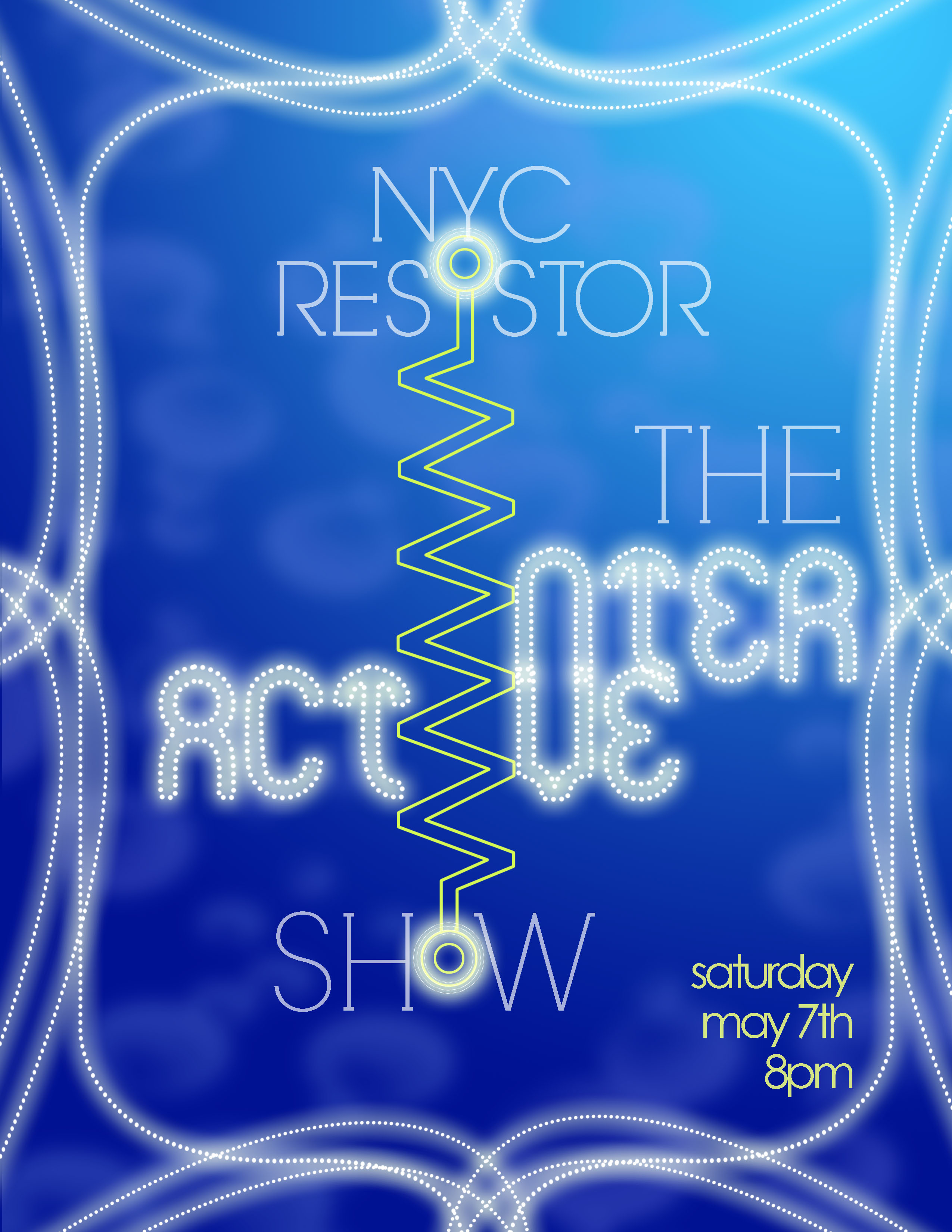
The weather’s getting warmer and it’s time to show off your projects. We’re throwing another interactive party on May 7th and we want to see your most awesomest stuff.
Contact us if you’re interested in displaying your work.

The weather’s getting warmer and it’s time to show off your projects. We’re throwing another interactive party on May 7th and we want to see your most awesomest stuff.
Contact us if you’re interested in displaying your work.

This is the first of a series of classes to help Japan recover from the effects of the devastating earthquake and tsunami of March 11th. All proceeds from this class will be donated to the Japan Society’s earthquake relief fund: http://www.japansociety.org/earthquake
This Satuday, March 26th, from 1-5 pm we’ll be having one of our periodic, super-awesome Arduino and soldering 101 classes! You’ll learn to solder! You’ll learn to program! You’ll learn to use microcontrollers! In fact, you’ll walk out the door twenty times more talented and amazing than you were when you walked in– and you’ll take a an Arduino-compatible board you assembled yourself with you.
In this four hour class you’ll:
* Solder together a Freeduino board (an Arduino Duemilanove-compatible board)
* Learn how to program it using the Arduino environment
* Wire up several circuits and load up code to read sensors and light LEDs
* Understand variables, functions, and basic Arduino functionality
* And more!
When you leave, you’ll have a micro-controller, a mini-USB cable and a few programs to play with.
You’ll need to bring a laptop with the Arduino environment installed. It’s available for all platforms at http://arduino.cc/en/Main/Software. (If you don’t have access to a laptop, please drop us a line at [email protected] ahead of time and we’ll try to find a spare for the day.)
The class will be taught by NYC Resistor members Adam Mayer and Nick Vermeer. Sign up here!
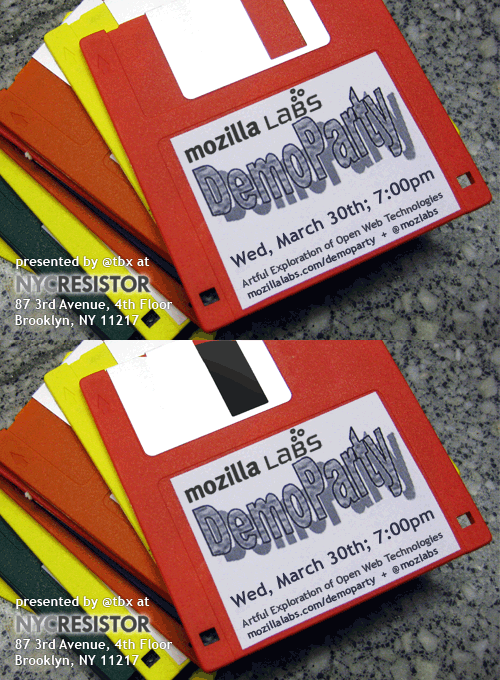
The Mozilla Labs* DemoParty is an upcoming online competition to foster artful development and exploration of Open Web technologies, taking inspiration from the classic DemoScene.
On March 30th 2011, 7pm, Tobias Leingruber** from Mozilla Labs and F.A.T. will present this project together with 2 special guests (TBA), and dive with us into the DemoScene culture and Open Web technology. Join us for a fun evening and free Pizza + Beer!
*Mozilla Labs is a virtual lab where people come together to create, experiment, and play with new Web innovations and technologies.
Crazy ideas and inspirations are encouraged as we all explore and experiment with brand new ideas in whole new ways. Mozilla Labs is about inspiring and harnessing the intelligence, wisdom, and energy of the Mozilla community; let’s imagine the future of the Web, and then let’s build it together.
**Tobias Leingruber (@tbx) is an artist and communication designer, researching in viral media, popular culture, amateur aesthetics and the future of the web.
As an advocate for openness and freedom online he has worked with many artists and organisations including the F.A.T. Lab, Artzilla.org and Mozilla. Best known for Pirates of the Amazon, Skate the Web and his latest work FB Resistance, he has exhibited work worldwide and has been covered by the NY Times, LA Times, Wired, Spiegel, 3sat(TV) and Liberation.fr.
Join us at NYC Resistor next Sunday, this month we have William Brent (http://williambrent.com/ ) in town joining us. He’s written the timbreID library for extracting detailed info from audio, as well as some video tracking objects for Gem, and of course uses them in his artistic works.
http://puredata.info/community/NYCPatchingCircle
We spend enough time alone staring at our computers; we are proposing to work together. So often issues that arise when working can be solved with a quick two minute discussion that would take hours to solve alone. We have Dorkbot to see people’s work, we have Share where anyone can play, we have workshops and universities to learn from. This is a meeting where we all can come to work.
This is an informal gathering of patching and patchers (Pd, Max/MSP/Jitter, and even vvvv, Eyesweb, Labview, etc.). Beginners and Experienced welcome. Open to everyone, students, the public, etc. Work on personal projects, professional projects, school projects, ask for help, help others, or just patch quietly to yourself, in a room full of other people patching patches and helping other people patch.
Sunday 3/27, 6-9pm
Free!

Some friends of mine have a house in the mountains in Steamboat Springs, Colorado. In the winter they dig a luge track in the (many feet of) snow in their yard and have timed sled races to see who can make it down the fastest. They call it the Mario Cup. I went out there last week with my buddy Mario (a member at Artisan’s Asylum and the namesake of the race) and we made some improvements to the system. Details below.
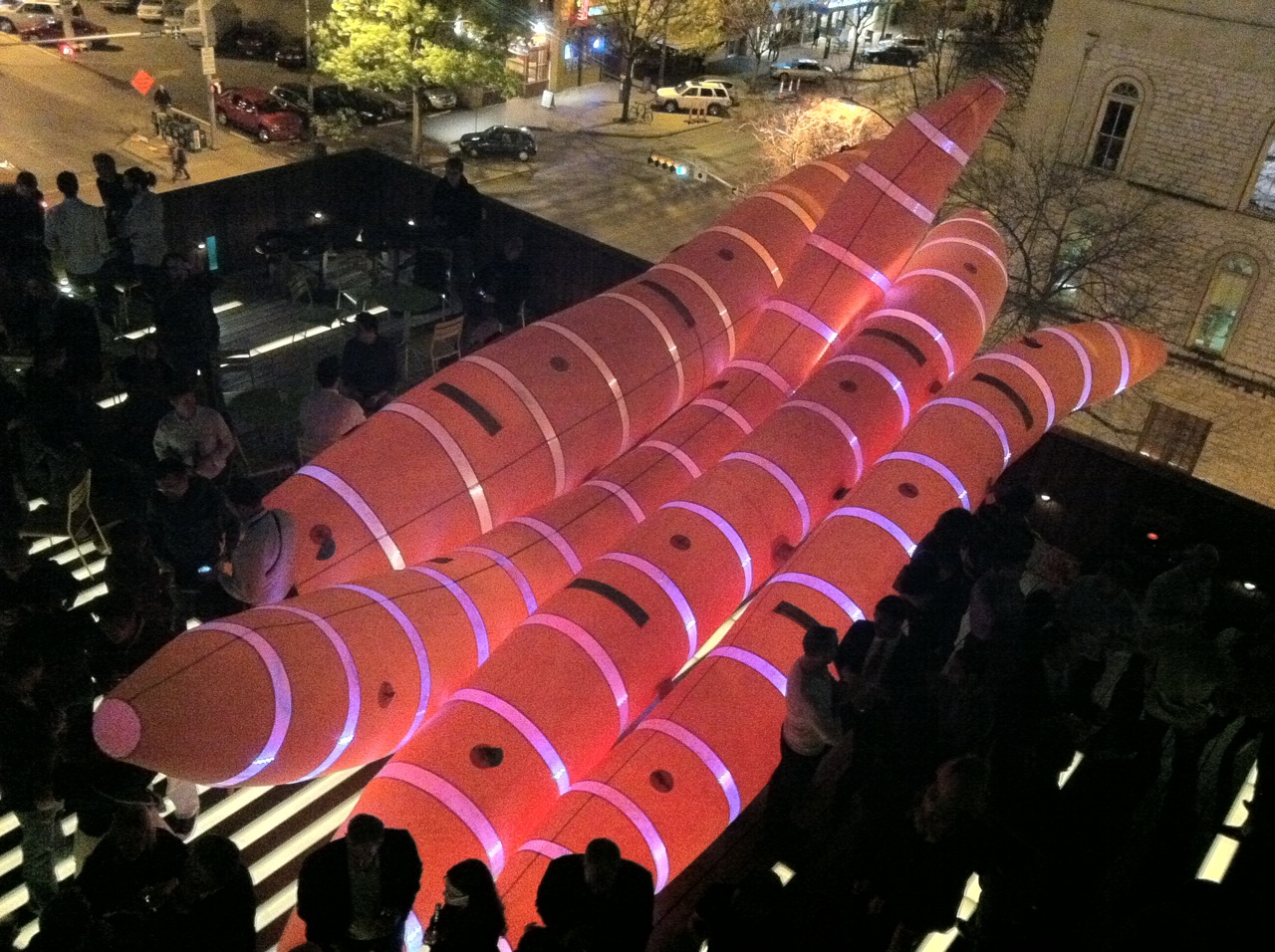
Here’s a quick wrap up of the Interactive Cuddlefish project I worked on with artist AK Airways for the SXSW party at the Arthouse. This massive inflatable sculpture was connected to a big red button which would change the sequences of the LEDs blinking inside. It was a fun project, but not without its challenges. Details after the break.

In honor of the successful final mission of the storied Space Shuttle Discovery, we’ve decided at great personal expense to have a last-minute Space Shuttle Discovery** Memorial Hack Fest at NYC Resistor this Saturday, March 12th, from 4:30 to 11 pm! Stop by with your crazy in-progress projects and help them progress! We’ll be having a show and tell at the end of the evening, so stick around and make things move, blink, and buzz!
*We will be selling pre-fried packets of exotic Ramen noodles at the attainable price of one dollar.
**Special thanks to the anonymous NASA employee who managed to snag us one of the hubcaps. We’ll make a plaque!
This is Bre Pettis playing a homemade 8-bit-style violin.
And this is where you can get plans and instructions to make your own!
thingiverse.com/thing:6912
The inPulse watch is a great platform to hack on. It has an ARM7, 32 KB of flash and 8 KB of RAM, Bluetooth, a buzzer, an OLED screen and a button. Not much by today’s standards, but plenty to play around with. The programming environment is very much like a microcontroller; no multitasking, no dynamic memory, and very constrained memory/cpu. That is, of course, what makes it so much fun. From very basic timekeeping contraction devices to today’s smartwatches, clocks have certainly evolved so much. If you wanna know more about the history or watch news, visit James Hampton-Smith’s blog called SpotTheWatch.
Continue reading »